
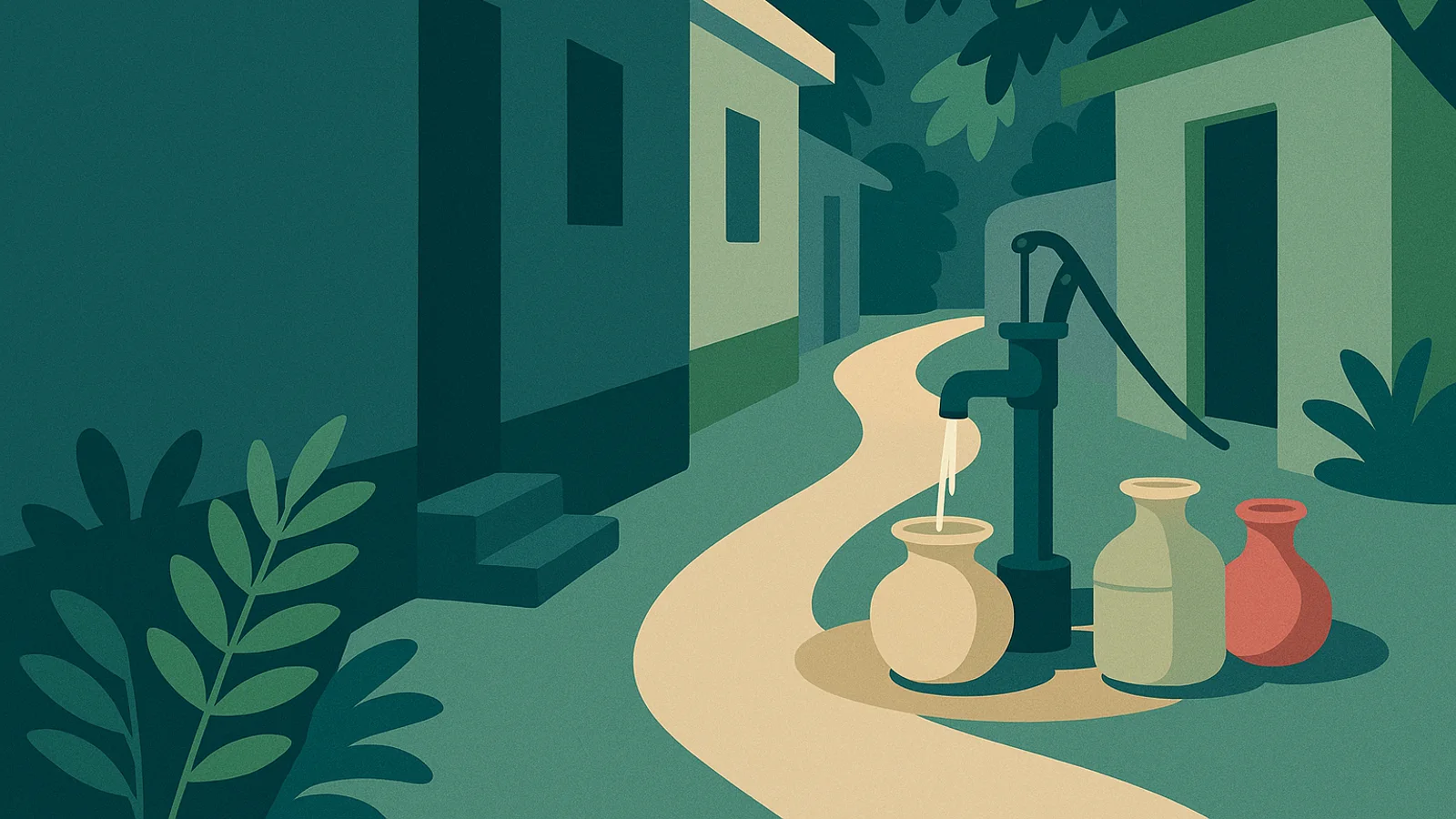
On [named lane / block, in a named ward or area], what is the typical distance and time households travel to collect their main drinking water, and who in the household usually carries it?
Complexity
Carrying Water Home: Distance, Time and the Person Who Carries Drinking Water on One Residential Lane
Alternative title — “Who Fetches the Water? Mapping the Daily Walk for Drinking Water on One Lane”
This study maps one residential lane to measure how far and how long households travel to fetch drinking water, and who in the family usually carries it. Students run a 40-60 household AKTI survey, conduct 6-10 interviews, take geo-tagged photos, and keep a field diary to compare source types and carrier identity. The goal is a street-level picture of the water-fetching burden, testing whether it falls more on women and girls.
Summary
On one named lane (a short residential street or block, "para" / পাড়া), this project asks: how far do households travel to collect their main drinking water, how long does it take, and who in the family usually does this work? The student team will run a household survey on AKTI Survey, interview people who fetch water or know the lane well, take geo-tagged photos of sources, routes and carrying containers, and keep a field diary. The team will map the lane, measure distances and trip times in categories, and compare households by source type (tube well, shared tap, vendor, pond) and by who carries the water (woman, girl, boy, man, hired help). At the end, the team will be able to say, for this specific lane, how far and how long water-fetching really takes, and whether the burden falls more on women and girls than on others.
Why this matters
In many Bangladeshi neighbourhoods, drinking water does not arrive by itself. Someone walks to a tube well, a shared tap, a pond, or a vendor's stand, fills a container, and carries it home — sometimes several times a day. This daily walk rarely gets measured. Parents assume "it is close enough." Teachers may not know that a student arrives late because she fetched water first. A local leader planning a new tube well may not know which part of the lane actually struggles.
This study turns an everyday, invisible chore into something countable: metres, minutes, trips, and a named person. For the families on this lane, knowing the real distance and who carries the load is the first step toward asking for a closer source, sharing the task more fairly, or protecting a child's school time.
Background
- Household surveys on water access usually report "improved" or "unimproved" source, not fetching distance or time in detail — BBS or MICS household survey reports [verify].
- International bodies track whether water collection takes under or over 30 minutes round trip as a global benchmark — WHO/UNICEF Joint Monitoring Programme (JMP) reports [verify].
- Water collection is widely described as "women's and girls' work" in rural and urban Bangladesh, but most reports are national, not street-level — NGO WASH sector reports, e.g. WaterAid Bangladesh or BRAC WASH programme reports [verify].
- Government water agencies publish records of tube well installations and coverage gaps by ward or union, but not walking distance per household — DPHE (Department of Public Health Engineering) reports [verify].
- Urban geography and public health literature discusses the "time tax" of water fetching and its link to missed school or work — academic journal articles on water, gender and time use [verify].
- Local government bodies (union parishad, ward councillors) sometimes hold informal lists of water point locations and complaints — union parishad or city corporation ward records [verify].
- Injuries from carrying heavy water (falls, strain, slipping on paths) are mentioned in WASH and public health literature but rarely counted at street level — community clinic or NGO field reports [verify].
- Distance and burden may differ sharply by local geography — coastal char erosion, hill-track stairs, haor flooding — but this is usually described in general terms, not measured lane by lane — regional development or disaster-management reports [verify].
Research question and hypothesis
Primary question: On [named lane / block, in a named ward or area], what is the typical distance and time households travel to collect their main drinking water, and who in the household usually carries it?
Secondary questions: (a) Does distance and time to the water source differ by source type (private tube well, shared tube well, piped tap, vendor, pond or river)? (b) Is there a pattern between who carries the water (adult woman, adult man, girl under 18, boy under 18, hired help) and household characteristics such as distance, source type, or household size?
Hypothesis: Households without a private source in their own yard will report longer distances and times, and will be more likely to rely on a woman or girl to carry water, compared with households with a source inside the home.
Null result: If distance, time, and who carries water are similar across all source types and household sizes, that is itself useful — it would suggest the lane is unusually equal, or that some other factor (not measured here) drives who carries water. Say this clearly if it happens; do not force a pattern that is not in the data.
Who should do this
Team size: 2 to 3 students work best — enough to split survey, interview and photo/mapping work, but small enough to coordinate easily on one lane. A single student can do this alone by following the timeline carefully and allowing more weeks for each task; a team of 4 can cover a longer lane or two nearby lanes for comparison, but must keep the unit of study clear ("this lane" or "these two lanes," named).
Fit by region:
- Dhaka: Dense lanes in older neighbourhoods or informal settlements often show a sharp contrast between households with a rooftop tank or inside tap and households relying on a shared tap down the lane or jar delivery. Distance may be short but trip frequency high.
- Chittagong: Hill-side lanes may involve stairs or slopes, which change the "burden" even if horizontal distance is short. Note elevation in the field diary.
- Noakhali: Char and coastal lanes may have longer distances to a working tube well due to salinity or erosion; some households may rely on pond sand filters or vendors bringing water from further away.
- Sylhet: Haor-edge or tea-garden-adjacent lanes may have seasonal path changes (mud, flooding) — describe the path condition on the day of visit, and note that this may differ in another season.
Role split for a team of 3-4:
- Survey lead: builds and manages the AKTI Survey, tracks response numbers, checks for missing answers.
- Interview lead: schedules and conducts video interviews, manages consent forms.
- Photo and map lead: takes geo-tagged photos, sketches the lane map, marks source locations and distance bands.
- Data lead: keeps the master spreadsheet, builds charts, checks for duplicate households. For 1-2 students, one person holds two roles in sequence rather than at the same time — for example, finish all survey visits before starting interviews.
Evidence plan
| Evidence type | What it shows for this question | How much is enough | Why it fits |
|---|---|---|---|
| AKTI survey | Self-reported source type, distance band, trip time, trip frequency, and who usually carries water, across many households on the lane | 40-60 completed household responses | Gives a countable pattern across the whole lane, not just a few visible cases |
| Video interviews | Lived detail behind the numbers: what the route feels like, what happens when a child is late, how things have changed over time | 6-10 interviews, 3-8 minutes each | Explains the "why" and "how" behind the survey numbers; captures voices the survey cannot |
| Geo-tagged photos | Visual record of actual sources, routes, containers, and distances; supports the map | 15-25 photos covering every source type found and at least 3 route segments | Lets the reader and advisor see the lane, not just read numbers |
| Field diary | Dates, times, weather, who was present, any problems or changes in plan | Entry for every visit day (expect 15-20 entries) | Shows the study is grounded in real dates and real conditions, and helps explain any season effect |
Survey design
Target respondent: an adult member of the household (18+) who is usually involved in water collection decisions, ideally the person who most often fetches water. One response per household.
- What is your household's main source of drinking water right now? — Single choice: Tube well in our own yard / Shared tube well outside our yard / Piped tap (WASA or municipal) inside our home / Shared or public tap outside our home / Water vendor (jar or bottle delivery) / Pond or river / Other
- Where is this main source located? — Single choice: Inside our home or yard / Outside our yard, on this lane / Outside this lane / Don't know
- About how far is it from your home to this source, one way? — Single choice: Less than 20 metres (about 25 steps) / 20-50 metres / 50-100 metres / 100-300 metres / More than 300 metres / Not applicable, water is delivered to our home
- About how long does one round trip (there and back, including waiting and filling) usually take? — Single choice: Less than 5 minutes / 5-10 minutes / 10-20 minutes / 20-40 minutes / More than 40 minutes
- How many trips does your household make to collect drinking water on a normal day? — Number
- Who in your household usually carries the drinking water home? — Single choice: Adult woman / Adult man / Girl under 18 / Boy under 18 / Hired help or domestic worker / It is delivered, no one carries it / Varies, no single person
- If a girl or boy under 18 usually carries water, about how old are they? Write 0 if not applicable. — Number
- In the last 7 days, has carrying water ever caused a child in your household to arrive late to school or miss school? — Single choice: Yes / No / Not applicable, no school-age child fetches water / Don't know
- What does your household usually carry drinking water in? — Multiple choice: Plastic jar or gallon container / Bucket / Clay pot (kolshi) / Pitcher / Other
- About how much drinking water does your household carry in total per day (your best estimate, in litres)? — Number
- Does anyone help carry water using a cart, rickshaw-van, or other vehicle? — Single choice: Yes, always / Yes, sometimes / No, always carried by hand or on the head / Not applicable, delivered
- Is your household's drinking water collected in the same trip as water for cooking and washing, or separately? — Single choice: Same source, same trip / Same source, separate trip / Different source entirely / Don't know
- In the past 12 months, has your household changed its main drinking water source? — Single choice: Yes / No / Don't know
- If yes, briefly, why did it change? — Short text (optional)
- How satisfied are you with the distance your household must travel for drinking water? — Scale 1-5 (1 = Very dissatisfied, 5 = Very satisfied)
- In the past year, has anyone in your household been injured (fall, strain, slip) while carrying water? — Single choice: Yes / No / Prefer not to say
- Would your household be willing to pay a small amount for drinking water delivered closer to home? — Single choice: Yes / No / Already paying for delivery / Don't know
- How many people live in your household? — Number
- What is the approximate age group of the person who carries water most often in your household? — Single choice: Under 12 / 12-17 / 18-40 / 41-60 / Over 60 / Varies, no single person
- Which part of this lane does your household live on? (Use the segment names your team defines before starting, for example "near the mosque end," "middle," "near the market end.") — Single choice, with team-defined options
Response target: 40-60 households, aiming to cover the full length of the lane.
Recruitment: Walk the lane door to door in daylight, in pairs if possible. Introduce the project, read the consent script (Section 10), and offer to fill in the survey together on a phone if the respondent prefers not to use their own device.
Pilot plan: Test the survey with 3-5 households first (not counted in the final 40-60, or counted if no changes needed). Watch for: confusing distance bands (does "20-50 metres" make sense to people, or should you show a visual reference like "half a cricket pitch"?), respondents unsure how to answer Q6 when multiple people share the task, and whether Q10 (litres) is too hard to estimate — if so, allow "don't know" as an accepted non-answer rather than forcing a guess. Adjust wording after the pilot, then start the full round.
Sampling and limits
Sampling method: Number every household on the lane in one direction (start from one named landmark, for example the mosque or the market entrance). Visit every household, or if the lane is very long (over 80 households), visit every second household, alternating sides of the lane. Record the total number of households on the lane and how many you reached, so readers know the coverage rate.
What this sample can claim: A clear, countable picture of distance, time and who carries water for the households surveyed on this named lane, on these dates.
What it cannot claim: Nothing about the whole city, region or country. Nothing about lanes you did not visit. Self-reported distance and time are estimates, not measured facts, unless you personally walked and timed the route (see Section 12).
Obvious bias and how to reduce it: People may answer on behalf of the household in a way that makes their situation look better or worse than it is (social desirability bias), especially for injury (Q16) or child lateness (Q8). Reduce this by keeping the tone neutral when asking, not reacting with surprise, and reminding respondents that answers are private and reported only in grouped form. Also watch for a time-of-day bias — if you only survey in the morning, you may miss households whose main water-fetcher is away at work; try to include some afternoon and early-evening visits.
Interview guide
Roles to interview (choose 6-10):
- An adult woman who regularly fetches water for her household
- An elder (60+) who remembers water collection on this lane years ago
- A girl or boy under 18 who fetches water (only with parent/guardian consent, described by role, not name)
- A tube-well mechanic or caretaker who services wells on or near this lane
- A water vendor or jar-water shopkeeper who delivers to this lane
- A school teacher or caretaker (about students arriving late due to water tasks)
- A union parishad member or ward representative
- A DPHE or local NGO WASH field worker, if available
- A community clinic worker (about injuries or health complaints linked to water carrying)
- An adult man who regularly fetches water, for comparison
Interview questions:
- On a normal day, how many times do you go to collect drinking water, and about how long does each trip take?
- Can you describe your route from home to the water source — is it flat, muddy, does it cross a road or path with traffic?
- Has carrying water ever made you or someone in your family late for school, work, or another duty? Can you describe a time this happened?
- Who else in your family shares this task with you, if anyone?
- Has the distance or the main source changed in the past five or ten years? What was it like before?
- Have you, or anyone you know on this lane, ever been hurt while carrying water?
- What would make this task easier for your household?
- (Mechanic) How often do you repair tube wells on this lane, and what happens to people's water distance when a well breaks down?
- (Vendor) About how many households on this lane do you deliver to, and roughly what do you charge?
- (Union parishad/DPHE/NGO) Are there any current plans to add a water point on or near this lane?
- (Teacher/caretaker) Have you noticed students arriving late, and do you know if water collection was ever a reason?
- (Clinic worker) Have you treated injuries that patients linked to carrying water (falls, strain)?
Consent script — read aloud before recording, in order: taking part, being recorded, being shared publicly.
English: "Hello. We are secondary school students doing a water research project for Rainflower Youth Research. We would like to ask you some questions about collecting drinking water. First: are you willing to take part in this interview? [wait for answer] Second: are you willing to be recorded on video or audio for our research notes? [wait for answer] Third: are you willing for us to share parts of what you say — without your name — in our research paper or presentation? [wait for answer] You can stop at any time, and you do not have to answer any question you don't want to. Thank you."
Bangla (approximate, check wording with a Bangla-speaking adult before use): "আসসালামু আলাইকুম। আমরা মাধ্যমিক বিদ্যালয়ের ছাত্রছাত্রী, রেইনফ্লাওয়ার ইয়ুথ রিসার্চের জন্য পানির গবেষণা করছি। আমরা আপনাকে খাবার পানি সংগ্রহ নিয়ে কিছু প্রশ্ন জিজ্ঞাসা করতে চাই। প্রথমত: আপনি কি এই সাক্ষাৎকারে অংশ নিতে রাজি আছেন? [উত্তরের জন্য অপেক্ষা করুন] দ্বিতীয়ত: আমরা কি আপনার ভিডিও বা অডিও রেকর্ড করতে পারি আমাদের গবেষণার জন্য? [উত্তরের জন্য অপেক্ষা করুন] তৃতীয়ত: আপনি কি রাজি আছেন যে আমরা আপনার নাম ছাড়া আপনার কথার কিছু অংশ আমাদের প্রবন্ধে বা উপস্থাপনায় ব্যবহার করি? [উত্তরের জন্য অপেক্ষা করুন] আপনি যেকোনো সময় থামতে পারেন, এবং কোনো প্রশ্নের উত্তর দিতে বাধ্য নন। ধন্যবাদ।"
Recording tips: Find a quiet spot, public and in daylight. Hold the phone landscape (sideways). Keep each clip 3-8 minutes. At the start of the recording, say the date and the person's role (for example, "9 October 2026, interview with a tube-well mechanic"), not their name. If the person prefers not to show their face, record their hands, the water point, or point the camera away from them while they speak.
Photo and observation plan
- The main water source itself (tube well, tap, pond edge) from a public viewpoint, no faces — shows what the source actually looks like.
- A wide shot of the route from a household's gate toward the source — shows the real path condition (paved, muddy, stepped).
- Close-up of a carrying container (jar, bucket, kolshi) — shows the tools people actually use.
- A person carrying water, from behind or side, with consent, face not shown if preferred — shows the physical task in progress.
- Your phone's map screen showing the measured distance between two points you walked (see Section 12) — supports your distance data.
- Any posted sign, rule, or notice near a shared source (for example, timing rules, ownership notice) — shows local rules in context.
- A storage container inside a home's entrance area (outside the private rooms, with permission) — shows how water is stored after carrying.
- A queue or gathering point at a shared source, if present, no identifying faces — shows demand at that spot.
- Any path hazard (broken pavement, open drain, slope, standing water) along a carrying route — supports injury-related interview answers.
- A hand-drawn or photographed sketch map of the lane, marking every water source and household segment — becomes your main map figure.
- A vendor's delivery cart or jars for sale, if a vendor serves the lane — shows the delivery option in context.
- Wide establishing shot of the lane itself, showing the general character of the neighbourhood (useful for the paper's description, not as evidence of any specific claim).
Turning on location tagging: On most phones, go to Camera settings (or Settings > Privacy > Location Services) and allow the Camera app to access location "while using the app." Check that a small location icon or geo-tag appears when reviewing the photo's details.
Photo log — record for every photo: photo number, date, time, place type (for example, "shared tube well," "route segment 2"), and one line on what it shows.
Rules: Never photograph a child's face without separate guardian consent for that specific photo. Never enter a home's private rooms; photograph storage containers only in entryways or courtyards with the household's permission. If someone asks not to be photographed, stop immediately and do not argue.
Optional measurements
All items below are OPTIONAL. The study works fully without them, using survey self-report and interviews as the main evidence.
- OPTIONAL — Measured distance: Walk the route yourself using a phone map app (recording start and end points) or by counting paces and converting to metres (an average adult pace is about 0.7-0.8 metres; state your own measured pace). Use this to check, not replace, the survey's self-reported distance bands for 5-10 example households.
- OPTIONAL — Timed trip: With the household's permission, time (with your phone's stopwatch) how long an actual round trip takes for 3-5 volunteer households, to compare against their self-reported time in Q4.
- OPTIONAL — Container volume: Measure the volume of common containers (jar, bucket, kolshi) using a labelled one-litre bottle, to turn "number of containers per day" into an approximate litre estimate, supporting Q10.
- OPTIONAL — Trip counting: With permission, observe one household's doorway for a set period (for example, one hour in the morning) and count actual trips made, to spot-check Q5.
None of these measurements test water quality or safety. This study describes distance, time and burden only — it does not claim anything about whether the water itself is safe to drink.
Timeline
| Stage | Weeks | What you do for this topic | What you submit |
|---|---|---|---|
| 1. Choose and plan | 1-2 | Pick and name the exact lane; sketch its rough length and landmarks; define distance bands and lane segments for Q3 and Q20; draft survey | Plan document, draft survey, named lane with a landmark description |
| 2. Permission, checklist, pilot | 2-3 | Get parental consent for any under-18 interviewee; tell families you will be walking the lane; pilot survey with 3-5 households; adjust wording | Coordinator checklist, piloted survey, consent forms ready |
| 3. First sample and advisor review | 3-4 | Collect first 10-15 household surveys; conduct 2-3 interviews; take first 5 photos; advisor reviews early data | First-sample data, advisor feedback notes |
| 4. Full data collection | 5-8 | Complete remaining household surveys to reach 40-60; complete all interviews; complete photo set; keep field diary current | Full survey dataset, all interview recordings, full photo log |
| 5. Analyse | 9-10 | Build charts (Section 14); cross-tabulate source type, distance, carrier identity; write first findings notes | Draft charts and tables, findings notes |
| 6. Write | 11-12 | Draft full paper following Section 17 outline; select best photos and quotes; write AI-use and ethics statements | Full paper draft |
| 7. Final review and submit | 13 | Coordinator checklist review; revise; submit paper and evidence package to Rainflower | Final paper, evidence package |
Analysis plan
What to count:
- Number and % of households by main source type (Q1)
- Number and % of households by distance band (Q3)
- Number and % of households by round-trip time band (Q4)
- Average and range of trips per day (Q5)
- Number and % of households by who usually carries water (Q6)
- Number and % reporting a child late/missed school due to water (Q8)
- Number and % reporting an injury (Q16)
Comparisons to make:
- Distance band vs source type (does private tube well mean shorter distance than shared or vendor-supplied households?)
- Carrier identity (Q6) vs distance band (does "girl under 18" appear more often at longer distances?)
- Carrier identity vs household size (Q18)
- Satisfaction (Q15) vs distance band
Charts to draw:
- Bar chart: households by source type (Q1)
- Bar chart: households by distance band (Q3)
- Stacked bar chart: carrier identity (Q6) broken down by distance band (Q3)
- Bar chart: % reporting child lateness (Q8), broken down by distance band
- Map figure: hand-drawn or photo-based sketch of the lane with sources, segments, and household counts marked
- Scale chart or scatter: trips per day (Q5) vs household size (Q18)
Worked example (example, not a result): Suppose 50 households respond. Imagine 18 report a private tube well, 20 a shared tube well, 8 a vendor, and 4 a pond. Imagine that among the 20 shared-tube-well households, 14 report "20-50 metres" or more, while among the 18 private-tube-well households, 15 report "less than 20 metres." Imagine that among households reporting "100-300 metres" or more (say, 10 households), 7 report that a girl under 18 usually carries the water, compared with 2 out of 15 households at "less than 20 metres." These numbers are invented to show the kind of comparison to make — your real numbers may look completely different.
Ethics and safety
Three permissions, asked separately, every time: (1) willingness to take part, (2) willingness to be recorded, (3) willingness to have words or images shared publicly. Use the script in Section 10 for interviews; for the survey, the first screen on AKTI Survey should state the purpose and ask for consent to take part before any questions begin.
Parental/guardian agreement: Required before surveying or interviewing anyone under 18, including a child who fetches water. Get this in advance through the household's parent or guardian, in person, before recording that child.
No identifying details: No full names, phone numbers, or house numbers in the paper. Describe people by role ("an adult woman who fetches water for her household," "a tube-well mechanic"). Use lane segment names (Section 8, Q20), not individual house identifiers.
Physical safety for this study: Work only in daylight, in pairs where possible. Stay on public paths; never enter a household's private rooms or yard without invitation. Avoid standing water, open wells, or unstable riverbanks when photographing sources. Tell a parent or guardian where you are going and when you expect to return, every time you go out. If a route involves slopes, stairs, or traffic crossings (common in hill or market areas), walk it first without a heavy bag to judge safety before bringing equipment.
Data privacy: Raw survey responses, interview recordings, and the household list stay in the private evidence package shared only with your coach, coordinator, advisor, and Rainflower. Only grouped numbers, anonymised quotes, and faceless or consented photos appear in the public paper.
Raw data retention: Keep raw survey exports, interview recordings, and the original photo log for the duration of the project plus the review period; delete personal identifiers (if any were accidentally recorded) as soon as noticed, and inform your coach.
Expected outcomes and limitations
Questions the data could answer:
- Is there a typical distance and time for water collection on this lane, or is it highly mixed?
- Does the burden of carrying water fall mainly on women and girls here, or is it more evenly shared than expected?
- Do households further from a source report more dissatisfaction, more injuries, or more child lateness?
- A null or surprising result — for example, no clear link between distance and who carries water, or carrying is shared roughly equally by gender — would suggest other local factors (household rules, availability of hired help, work schedules) matter more than distance alone on this lane. This is a legitimate and useful finding; report it honestly.
Limitations (write these in the paper):
- Self-reported distance and time are estimates, not GPS-measured facts, unless checked (Section 12).
- The sample covers one lane on specific dates; it cannot represent the whole neighbourhood, city, or country.
- Sensitive answers (injury, child lateness) may be under-reported due to social desirability.
- Season at the time of data collection (dry or wet) may affect path condition and should be noted and discussed, not treated as representative of all seasons.
Paper outline
- Abstract (150-200 words): question, lane, method, headline numbers, one sentence on what it means locally.
- Introduction: why water-carrying burden matters on this lane; what is known generally (Section 4 background, marked [verify]); the research question.
- Methods: lane description and landmark, sampling method, survey questions summarised (full list in appendix), interview roles, photo plan, dates of data collection, any optional measurements used.
- Results: survey findings with tables and charts (Section 14), interview quotes (anonymised, by role), described photos with figure numbers, the lane map.
- Discussion: what the comparisons suggest, how they relate to the hypothesis, how local geography (hill, char, haor, dense urban lane) may explain patterns.
- Limitations: the four points above, plus anything specific that happened during fieldwork.
- Conclusion: one clear takeaway for this lane; one suggestion for who locally might use this finding (family, teacher, union parishad).
- AI-use statement: exactly what AI was used for (grammar, formatting) and what it was not used for (no invented data, results, or quotes).
- Ethics statement: consent procedures followed, how privacy was protected.
- References: background sources, each marked [verify] if not personally checked in full.
Figures/tables to include: lane sketch map; source type bar chart; distance band bar chart; carrier identity stacked bar chart; summary table of key numbers; 2-3 selected photos with captions.
Word range: 1,800-3,000 words (excluding references and appendix survey list).
Budget
| Item | Reason | Cost (BDT) |
|---|---|---|
| Local transport (bus/rickshaw/auto) for repeat lane visits | Multiple visits across 13 weeks | 1,200 |
| Mobile data top-up | Uploading survey responses, video interviews, photo backups | 800 |
| Printing consent forms and photo log sheets | Paper copies for field use | 400 |
| Notebook and pens | Field diary | 150 |
| Small courtesy item for interviewees (e.g. tea/snack, modest) | Respectful thank-you, not payment for answers | 600 |
| Printing final lane map and key photos for the paper | Clear figures for submission | 350 |
| Contingency (unexpected small costs) | Buffer | 300 |
| Total | 3,800 |
Estimated hours per student (total across 13 weeks): 60 hours Breakdown: Plan and consent (Stage 1-2): 8 hours — Pilot and first sample (Stage 3): 7 hours — Full data collection (Stage 4): 22 hours — Analysis (Stage 5): 8 hours — Writing (Stage 6): 10 hours — Final review (Stage 7): 5 hours.
Before-you-start checklist
- Named the exact lane, with a clear starting landmark and approximate length
- Defined lane segments and distance bands before piloting the survey
- Built the survey in AKTI Survey and tested the link works on a phone
- Prepared parental/guardian consent forms for any under-18 interviewee
- Told a parent/guardian your daily field schedule before each visit
- Identified at least 6 interview roles and how to reach each one
- Checked phone camera location tagging is switched on
- Piloted the survey with 3-5 households and noted any needed changes
- Reviewed the three-permission consent script in both languages
- Set up a shared spreadsheet or folder for survey exports, photos, and the field diary
- Confirmed route safety (no fast water, open wells, unstable banks, heavy traffic) before walking it
- Shared the plan with your coach for first review
Glossary
- Tube well (নলকূপ): A hand-pumped or mechanical well that draws groundwater through a pipe.
- WASA: Water and Sewerage Authority, the government body supplying piped water in some cities.
- Kolshi: A traditional clay or metal pot used to carry or store water.
- DPHE: Department of Public Health Engineering, the government body responsible for rural and small-town water supply.
- Union parishad: The lowest elected local government body in rural Bangladesh.
- Char: A temporary island or land formed by river sediment, common in coastal and riverine areas.
- Haor: A large wetland/floodplain basin common in the Sylhet region, flooded in the monsoon.
- Geo-tag: Location information (coordinates) attached automatically to a photo by a phone.
- Consent: A person's clear agreement, given freely, to take part in research, be recorded, or be quoted.
- Field diary: A dated, written record of what the researcher did, saw, and observed each day in the field.
- AKTI Survey: The free online survey tool used by Rainflower students to build and collect survey responses.
- [verify]: A note meaning the student must check this fact or source before relying on it in the final paper.
Share this proposal with your Rainflower coordinator before starting any fieldwork. Bring back any questions or requested changes, and you can adjust the survey, sample size, or timeline together.
Skills you'll use
Want to write this?
Take it on as a Rainflower researcher, get matched with a coordinator, and earn 💧 3000 when Rainflower accepts your paper.
Questions
Sign in to read and ask questions about this paper.